


Natural Resources Advisory
-
The energy transition is providing a unique and urgent requirement for the transfer of skills, experience and technology from the oil & gas industry into the geothermal industry.
From the launch of our company in 2021, we recognised that the geothermal power generation technologies being transitioned from proven oil and gas technologies would only be successfully deployed if the skills and experience from the oil and gas industry could also be effectively transitioned.
Through our extensive network and inhouse expertise we can offer:provision of oil and gas expertise and technologies into the geothermal industry
support for oil and gas companies with their geothermal investments and project implementation
-
Geothermal Power Project Management
We are the Operator of all our baseload power projects in Germany and in Switzerland.
As Operator for Project THERMO, ZeroGeo completed the 5’000 km² Air-FTG Survey in Lower Saxony in late 2022/early 2023 and undertook the application process for the two geothermal exploration permits in 2024.
Our management, commercial and technical team has decades of experience in advising on energy project development & project management, subsurface resource exploration and Government license negotiations, with proven success in the energy industry and in renewable energy. -
Delivering Oil & Gas expertise and technologies into the Geothermal Industry
Please see below for our case study: Airborne Full Tensor Gravity Gradiometry acquisition and modelling for deep geothermal exploration
Supporting Oil and Gas, Utilities and Renewables companies with their Geothermal Projects
We are in discussion with a number of companies about:
transitioning their legacy assets into geothermal electricity production.
re-purposing of end-of-life oil and gas wells to geothermal power generation.
new drilling to co-locate geothermal power generation alongside PV solar and wind turbine farms.
Please see below for our case study:
Our recent experience
Delivering Oil & Gas expertise and technologies into the Geothermal industry


Image credit: Bell Geospace Limited
Case study: Airborne Full Tensor Gravity Gradiometry acquisition and modelling for deep geothermal exploration
Benefits of Full Tensor Gravity (Gradiometry) FTG
FTG was originally developed by Lockheed Martin for military applications and has been utilised more and more over the past 20 years by both the mining and petroleum industries. Air-FTG™ is a trademark of Bell Geospace Limited.
The primary benefits over and above traditional land base gravity surveying are two-fold:
Airborne acquisition enables the survey to be completed in a vastly reduced timescale than traditional land based methods.
FTG records the second derivative of the gravity field (the ‘Tensor) simultaneously and in parallel with the scalar gravity, enhancing the efficiency of the acquisition process.
The significance of this ‘dual’ recording is that the modelling capabilities are significantly enhanced.
The derivative or ‘rate of change’ of the gravity field provides a remarkable increase in the resolution of the abrupt subsurface density changes often associated with faults, graben margins, volcanic intrusions and in particular salt intrusions and diapirs.
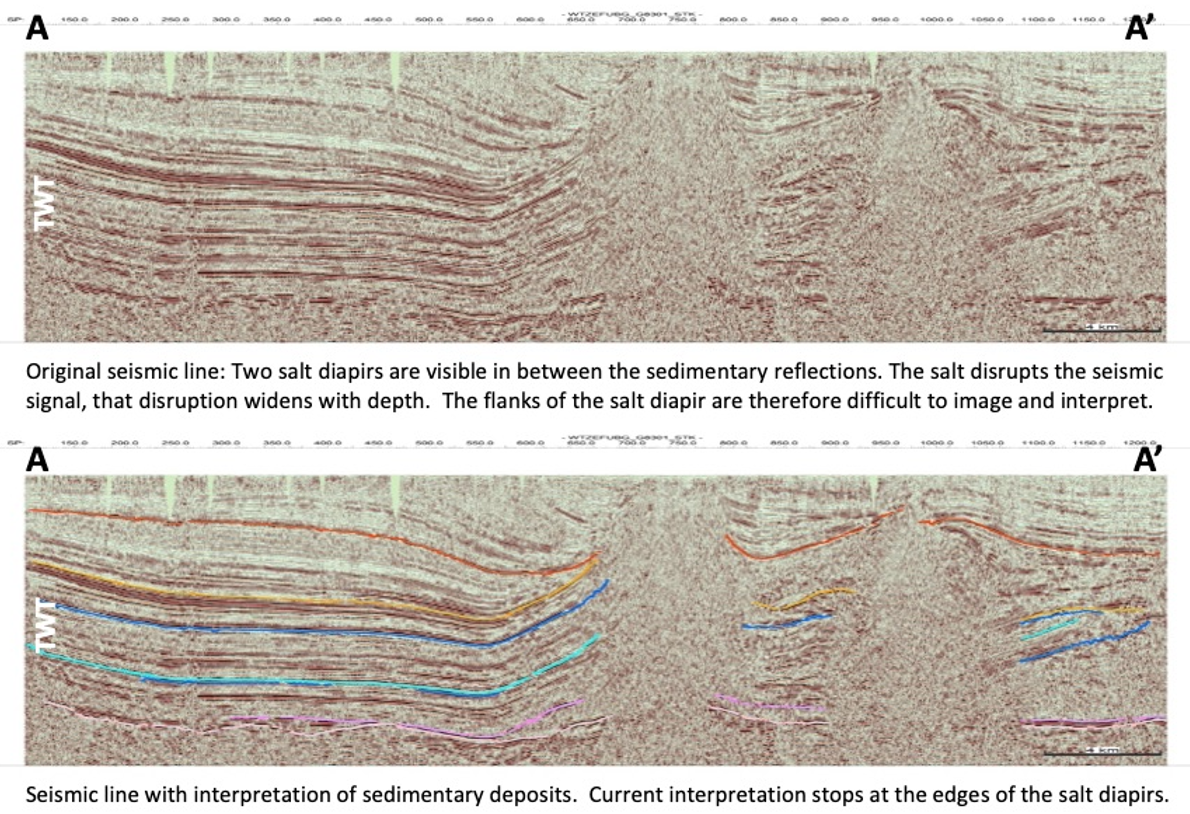
To determine the potential of forward 3D modelling of the Projekt THERMO Air-FTG, indicative 2D modelling was undertaken by Metatek Group Limited using a 2D seismic line in the area.
How do we utilise the Air-FTG™ gravity survey to reduce geothermal exploration risk?
To understand the salt structure in the subsurface. Seismic signals are often unable to penetrate subsurface salt, therefore making imaging beneath salt difficult. Are there rocks below the salt that can be targeted for geothermal exploration, or is it all salt?
In the example 2D seismic section below used for forward gravity modelling we can see two salt diapirs in the sedimentary section. The salt disrupts the seismic signal, that disruption widens with depth. The flanks of the salt diapir are therefore difficult to image and interpret. The current interpretation stops at the edges of the salt diapirs.

The Air-FTG™ data allows us to model the thickness and distribution of the salt in areas where the seismic doesn’t penetrate. In Model 1 of the 2D seismic section we mapped the salt as a large thick body. However, the gravity response we would expect from that model doesn’t match the FTG data.
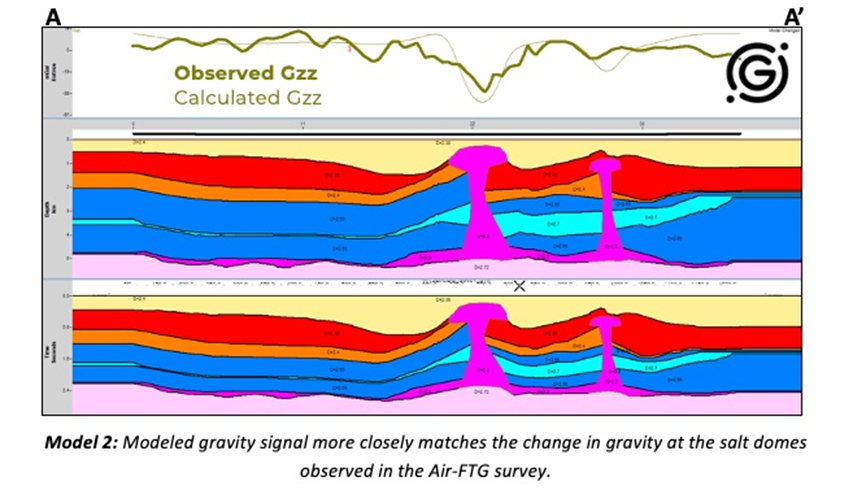
In Model 2, we changed the thickness of the salt so that it is a true diapir, with a thick bulbous top and a thin salt feeder.
Supporting Oil and Gas, Utilities and Renewables companies with their geothermal projects

We are in discussion with a number of companies about:
transitioning their legacy assets into geothermal electricity production
re-purposing of end-of-life oil and gas wells to geothermal power generation
new drilling to co-locate geothermal power generation alongside PV solar and wind turbine farms
Case study: OMV
As the Operator we partnered with OMV on an advanced geophysical exploration programme to acquire an airborne 5’000 km² Air-FTG Survey from November 2022 to February 2023, to evaluate the geothermal prospectivity in Lower Saxony, Germany. The Air-FTG survey was acquired by Bell Geospace Limited.
This was the first time Full Tensor Gravity has been acquired in Europe for geothermal exploration, yet is a technology proven in oil and gas exploration to reduce risk in subsurface resource exploration.

Image credit: Bell Geospace Limited